Movie and show soundtracks carry a strange kind of emotional weight that a lot of people underestimate until they hear a specific cue again years later. A particular swell of strings right before a big reveal, a character’s theme playing under an emotional scene, a specific line of dialogue delivered exactly right – these moments live in a lot of people’s memory long after the plot details have faded, and there’s something genuinely satisfying about being able to carry a piece of that around as your own ringtone or notification sound.
The obstacle has never really been wanting this. It’s been the fact that getting a clean audio clip out of a movie or show, precisely trimmed to the moment you actually want, used to require more effort than most people were willing to put in for a ringtone.
Why OST Ringtones Hit Differently Than Generic Ones
A default ringtone is just a sound. A ringtone built from a specific soundtrack moment – a theme that means something to you, a line of dialogue that’s become a personal joke, a musical cue tied to a favorite scene – carries context a generic tone never will. Every time your phone rings, you get a small, specific reminder of whatever that moment meant to you originally, which is a genuinely different experience than hearing the same default chime everyone else’s phone makes too.
This is really why OST-based ringtones have stayed popular for as long as personal ringtones have existed at all, even as the technical means of making them have shifted dramatically over the years.
Getting the Audio Out of the Video
Most people don’t have access to isolated soundtrack files – movie and show music generally isn’t released as easily downloadable individual tracks for most productions, and even when a soundtrack album exists, it doesn’t necessarily include every cue or line of dialogue someone might want. The video itself is usually the only accessible source for a specific moment.
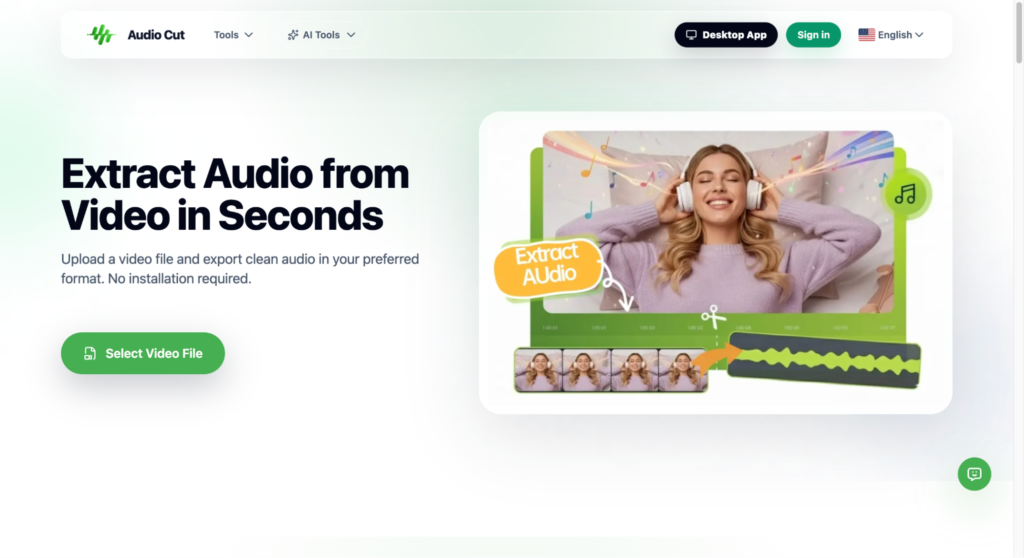
Easily extract audio from video files without downloading extra apps using audiocut.io. Once the audio track is pulled from the video, you’ve got a raw source to work with – the specific scene, in audio form, ready to be trimmed down to exactly the segment you actually want to use.
Trimming Down to the Exact Moment
Extraction gets you the audio; trimming gets you the ringtone. Most memorable moments in a soundtrack or scene are a matter of a few seconds within a much longer piece of audio, so precise trimming matters here more than it might for other use cases – you want the exact swell, the exact line, the exact beat, not a rough approximation that includes too much before or after the part you actually care about.
Crop your favorite dialogue snippets in seconds using a free online audio cutter like audiocut.io. Dragging the markers over a waveform view makes this precision easy to get right, since you can see roughly where the audio changes and adjust the selection until it lines up exactly with the moment you want to capture.
Dialogue Snippets Versus Musical Cues
It’s worth distinguishing between the two most common types of OST-inspired ringtones, since they behave a little differently when it comes to trimming. Musical cues tend to have a more forgiving structure – a few seconds anywhere within a swell or theme usually sounds intentional, since music naturally builds and resolves in a way that’s easy to cut cleanly. Dialogue is less forgiving; cutting mid-word or leaving in an awkward half-second of silence before or after a line makes the clip feel sloppy in a way music rarely does. Taking a bit more care with the exact start and end points matters more for a dialogue-based ringtone than for a musical one.
A Note on Personal Use
Custom ringtones made from dialogue or score, for a purely personal use case, are of minimal importance, but as I always remind everyone who asks this question, the ownership of that content (sound clip) rests with the creators of that movie/show. Having personal use on your device is a much more private scenario than creating and sharing a ring tone, more so, outside of your own handset.
Building a Small Collection Over Time
A lot of people who do this once end up doing it again for other favorite moments over time, gradually building a small rotating collection of ringtones and notification sounds pulled from shows and movies that mean something to them personally. There’s nothing complicated about this habit – it’s really just a byproduct of extracting a clip whenever a scene or line feels worth keeping around in that specific, small, personal way, rather than staying buried in a two-hour film you’re unlikely to rewatch again just to hear one favorite moment.
That’s really the appeal of the whole process: turning something you already loved once, buried inside hours of other content, into something small and personal you actually get to experience again regularly, every time your phone happens to ring.
Where to Start if You’ve Never Tried This
Start at the Source If there is only one TV or film scene- whether it is a one-liners , motif or musical idea-there is, at any given time, running through your head incessantly, it will save some time to start there, as opposed to making an all-encompassing list of a dozen tonal ideas and their associated snippets before the first ones is even implemented to make sure the tone in your mind “Works”. Find your scene and extract the audio, edit it to be precisely what you are referring to, and make it your tone. On the occasion-Should you ever actually get “the chance,” so to speak-that you yourself should actually simulate the tones to you the first time your phone does, only then will you know “if this warrants the attempt and subsequent memories to be built from this” and this would be a fairly simple process for additional favorites to follow.
Find your scene and extract the audio with audiocut.io, edit it to be precisely what you’re referring to, and make it your tone. On the occasion your phone rings for the first time with that custom sound, you’ll know immediately whether it was worth the effort — and the process is simple enough to repeat for all your other favorites.