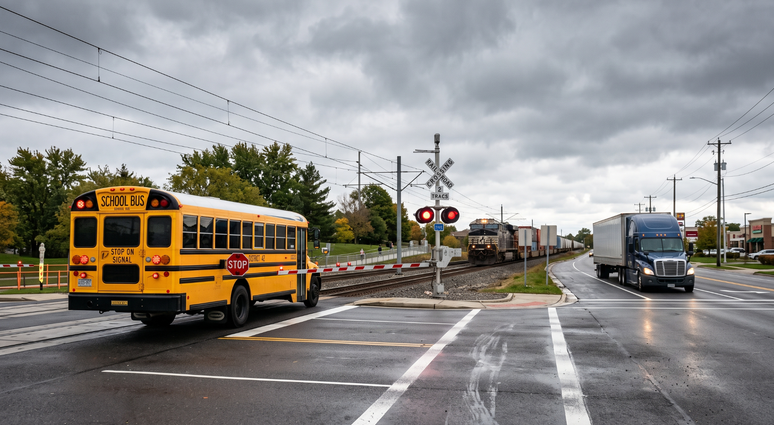
In the span of six days, two school buses carrying young children were struck near railroad crossings on the same stretch of road in Jacksonville, Florida. On April 2, 2026, a tractor-trailer rear-ended a bus carrying kindergarteners from San Pablo Elementary School as it sat stopped at the tracks on Zoo Parkway. Six days later, on April 8, a tow truck struck a second bus carrying first and second graders from John E. Ford Elementary School, also halted at a nearby crossing after a field trip to the Jacksonville Zoo and Gardens. No students were killed, but more than a dozen children were hospitalized for evaluation, and a community was left asking how the same crash could happen twice in under a week.
A Pattern Emerges on Zoo Parkway
In the first crash, the truck driver told investigators his brakes had failed as he approached the stopped bus. In the second, a tow truck struck the rear of a bus that, like the first, was parked at the crossing exactly as federal and Florida law require. Duval County Public Schools Superintendent Dr. Christopher Bernier called the back-to-back incidents “tragic” and announced a district-wide safety campaign urging drivers to slow down and stay alert near stopped buses and rail crossings. For researchers who study road safety, the cluster is a familiar and troubling pattern: a single hazardous location, combined with driver inattention or mechanical failure, repeating itself before anyone has time to intervene.
Why Railroad Crossings Put School Buses at Heightened Risk
Federal regulations require school buses to stop between 15 and 50 feet from the nearest rail, open their doors, and visually confirm no train is approaching before crossing, as detailed by the National Highway Traffic Safety Administration. That mandatory stop is what keeps children safe from trains, but it also creates a predictable point where a bus must come to a complete stop in moving traffic, which shifts the danger from the tracks to the vehicles approaching from behind.
The Federal Railroad Administration reports more than 2,000 highway-rail crossing incidents and roughly 200 fatalities nationwide each year, and notes that while these collisions represent a small fraction of all motor vehicle crashes, they account for a disproportionate share of fatalities relative to their frequency. Researchers at UC Berkeley’s Safe Transportation Research and Education Center have studied the long-term decline in grade-crossing crashes over recent decades, attributing much of the improvement to signal upgrades, gate systems, and grade-separation projects, work that underscores just how much engineering and driver behavior both matter at these locations. NHTSA’s own guidance on planning safer school bus stops and routes similarly recommends keeping stops well clear of crossings precisely because of the compounding risk when two hazards, a stopped bus and an active track, sit close together.
The Institutional Response in Duval County
Beyond the public safety campaign, DCPS officials have acknowledged that Zoo Parkway itself may need a closer look, from signage and driver visibility to whether bus routes and field-trip stops near that crossing should change. Transportation safety researchers generally agree that lasting fixes at high-risk crossings combine three elements: engineering changes to the roadway or signals, enforcement of stopping laws, and sustained driver education, none of which work in isolation. A repainted stop bar or a redesigned route can matter more than most drivers realize on a corridor that already carries heavy field-trip traffic to the zoo.
Officials have also noted that field trips concentrate large numbers of buses on the same roads within a short window, making an already risky crossing busier during peak travel times. Reviewing scheduling patterns, not just the crossing itself, may end up being part of any long-term fix Duval County adopts.
What Injured Families Need to Know
For the families of the children involved, the response from schools and regulators matters, but so does understanding their legal options. Liability in crashes like these can extend well beyond the driver who struck the bus. Trucking and towing companies can be held responsible for a driver’s actions, mechanical failures such as bad brakes, and inadequate vehicle maintenance, and the window to gather evidence, dash camera footage, electronic logging data, and maintenance records, narrows quickly after a crash. Florida generally allows two years to file a negligence-based injury claim, making early legal guidance important rather than optional.
Experienced attorneys who handle serious injury claims can make a meaningful difference here, helping families secure time-sensitive records, identify all potentially liable parties, and pursue fair compensation for medical care, therapy, and the emotional toll these crashes take on children. Parents who are unsure whether their child’s evaluation and treatment justify a claim are generally better served asking early than waiting until records have been discarded or memories have faded.
A Community Watching Every Crossing
Two crashes on the same road in the same week is not a coincidence researchers, regulators, or families can afford to shrug off. It is a signal that a specific location, a specific set of driving habits, or both, need direct attention before a third incident occurs. Jacksonville’s experience is now part of the broader body of evidence that safety researchers, school districts, and legal advocates all draw on when arguing for better-designed crossings, stricter enforcement, and swifter accountability when negligence puts children at risk on their way to and from school.