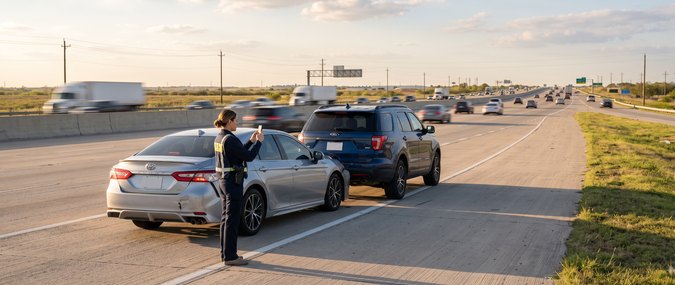
Most of what determines the outcome of a collision claim is decided before anyone has decided to make one. The evidence that will matter in eighteen months is generated, or lost, in the first three days.
This is not a matter of legal strategy so much as basic record-keeping under bad conditions. What follows is what the first 72 hours actually require, and why each step matters later.
Hour Zero: What Texas Law Requires at the Scene
Two duties attach immediately, and both are statutory.
Under Section 550.023 of the Texas Transportation Code, a driver involved in a collision causing injury, death, or vehicle damage must give their name, address, vehicle registration number, and liability insurer to anyone injured and to the other driver, show a driver’s license on request, and render reasonable assistance, including arranging transport for medical treatment where it is apparent that treatment is needed.
Section 550.026 adds a separate reporting duty: where the collision caused injury, death, or damage severe enough that a vehicle cannot be driven safely, the operator must immediately give notice by the quickest available means to local police, or to the sheriff’s office where the crash occurred outside municipal limits.
Practical consequence
Do not agree to handle a crash privately because the damage looks cosmetic. Bumper covers hide structural damage, and a collision serious enough to injure someone is one where a police-generated report is the only neutral contemporaneous account that will exist.
Hours 1 to 6: Capture What Will Not Survive
Physical evidence at a crash scene has a short life. Debris fields get swept, fluid trails evaporate, and vehicles are towed to lots where access becomes complicated.
Photograph more than seems necessary, and photograph the things that are not obviously about the crash: the position of the vehicles before they are moved, the state of the road surface, sight-line obstructions, traffic control devices and their timing, weather and lighting conditions, and the surrounding businesses.
That last one matters more than people expect. Commercial security footage is typically overwritten on a cycle measured in days. A note of which storefronts face the intersection is often the difference between having video and not.
Hours 6 to 24: Get Evaluated, Even If You Feel Fine
Adrenaline masks injury reliably enough that “I felt fine at the scene” is close to universal in serious cases. Soft tissue injuries, concussions, and nerve compression frequently declare themselves a day or more later.
A same-day or next-day medical evaluation does two things. Clinically, it catches what the scene missed. Evidentially, it creates a dated record connecting symptoms to the event, closing the gap that otherwise gets characterized as evidence that the injury came from something else.
Hours 24 to 72: The Report, the Notice, and the Recorded Statement
Locate the crash report
The investigating agency’s report becomes available through TxDOT’s crash records system. Obtain it and read it carefully, because reports contain errors, misidentified directions of travel, wrong vehicle assignments, and incorrect insurance information and corrections are far easier early.
Notify your own insurer, carefully
Your policy requires prompt notice, and that obligation exists regardless of fault. Notification is not the same as giving a recorded statement to the other driver’s insurer, which is a separate request and one you are not obligated to grant on their schedule. The Texas Department of Insurance auto insurance guide sets out what your own coverage requires and what the claims process involves.
Watch what you post
Social media activity in the days after a crash becomes evidence with unusual regularity. A photograph at a family event, a cheerful update meant to reassure relatives, or a check-in at a gym gets offered later as proof that an injury was minor, stripped of the context that the person left early and spent the next day in bed.
The same applies to text messages describing the crash to friends, which are discoverable and are often written in a downplaying tone people use with people they do not want to worry.
The government-vehicle exception
If the other vehicle belonged to a city, transit authority, school district, or other governmental unit, an entirely different clock starts. The Texas Tort Claims Act requires notice to the governmental unit within six months, and city charters may impose substantially shorter periods. San Antonio’s is among those measured in days rather than months. Missing it can end a claim that would otherwise have been straightforward.
Why the Early Record Carries the Case
According to Shaun M. Serelson, Partner and Managing Attorney of RTRLAW’s personal injury pre-litigation division, who handles matters in both Texas and Florida from the date of the accident forward, the disputes that become expensive later are almost always about facts that could have been settled cheaply in the first week, whether a light was green, whether a vehicle was actually disabled, and when symptoms began. Because that window closes quietly rather than obviously, San Antonio local injury attorneys generally advise getting the report, the photographs, and the medical evaluation into the file before deciding whether a claim is worth pursuing at all.
A Simple 72-Hour Sequence
Report the crash and get a police-generated record. Photograph everything before vehicles move. Note nearby cameras. Get medically evaluated within a day. Pull the crash report and check it for errors. Notify your own insurer. Identify whether any government vehicle was involved. Decline to give a recorded statement to the other side until you understand what is being asked.
None of that requires deciding to pursue anything. It just preserves the option, which is the entire point of the first three days.